
Interview: L.V. Peñalba’s Shapes of Love
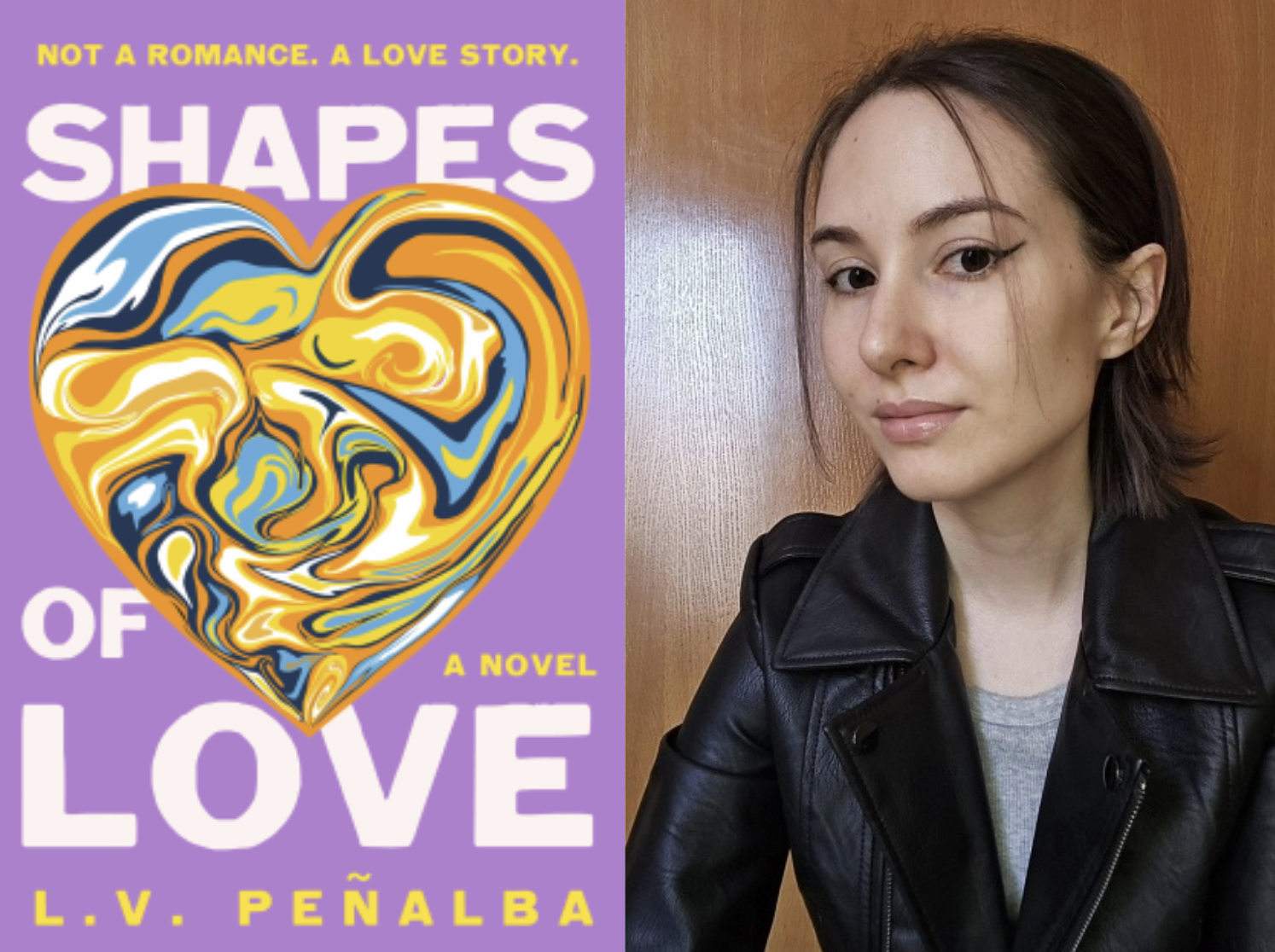
Shapes of Love book cover, and L.V. Peñalba’s headshot.
The Writing Owl: What inspired you to write Sasha's story?
L.V. Peñalba: I wanted to write a love story where falling in love wasn’t necessarily the endgame. Romantic love, especially heteronormative romance, is often portrayed as the key to happiness, and platonic love as a consolation prize. I wanted Sasha to get the happy ending she wants instead of what society tells her she should want.
Looking at how fans get curious about artists’ love lives, I started wondering what would happen if there was a famous singer who was aro/ace-spec but people assumed she was straight, and whether her fanbase would create a fairytale, or how her label would want to profit off her.
Shapes of Love revolves around Sasha, the person, rather than Sassy, the artist. A lot of the things she’s going through come down to her personal life, like the way she’s growing apart from her friends or how they seem more focused on their romantic partners. Sasha feels lonely, which people tend to associate with being single, but she doesn’t want a romantic partner. This story is about her fighting back against the idea that life is empty without romance and sex, championing the importance of friendship, learning more about QPRs (Queerplatonic Relationships), and finding what shape of love fits her.
The Writing Owl: Why do you think the queer community has such strong ties to fanfiction and writing about their favorite characters?
L.V. Peñalba: I think fanfiction allows many queer people to feel seen and represented in a way that can sometimes be missing in media. In particular, for the a-spec community, it can also be a tool to explore identity and share different experiences under the umbrella that haven’t gotten much visibility yet.
Characters can be a huge source of comfort, community and discovery, and reading about them can be healing, almost like a form of therapy. Also, it’s fun!
The Writing Owl: Platonic relationships are just as important as romantic ones, and you're showing this within your story. Why was it important for you to tell a story like the one between Sasha and Kai?
L.V. Peñalba: I don’t like the expression ‘more than friends,’ or the belief that romantic relationships have to be prioritized above everything else because platonic love pales in comparison. With Shapes of Love, I wanted to push back against the idea that being aromantic or asexual means loneliness, or an absence of ‘love.’ Love doesn’t have to conform to a standard to count. It’s also not a monolith where romance sits at the top; it’s a malleable thing each person gets to sculpt.
When it comes to Sasha and Kai, there’s still this perception that when a man and a woman are really close, they will eventually fall in love. Sasha’s fans want them to be this dreamy romantic couple, even if that’s not the shape of love that fits them. You can even see Sasha and Kai joke about it at some point, “historians will call us lovers.” Their journey is one of discovery, connection, and carving a space that allows them to be their real selves. A-spec people have so much love to give, and I hope this story and characters reflect that.
The Writing Owl: Why do you think that Aroace representation is lacking when we talk about the LGBTQIA community?
L.V. Peñalba: I think a-spec identities are still minimized, but I believe things are slowly changing for the better. I would recommend checking out Yasmin Benoit’s work—she’s talked about how some people still perceive being aromantic or asexual as a ‘choice,’ a ‘medical issue,’ or a problem that needs ‘fixing.’ Sometimes they hit you with the classic, ‘you just haven’t found the right person yet,’ or with a string of misconceptions and intrusive questions.
I’ve found that some people also struggle to understand that romantic and sexual attraction are different things, and that not everyone experiences them in the same way, if at all. Normative structures around attraction, relationships and gender are so deeply ingrained in our society that they bleed into many daily interactions. We’re taught to believe that it’s better to destroy yourself to fit into what society demands of you. But living authentically in a way that honors the real you and showing these experiences is liberating. It’s brave to say, “I exist, and I’m exactly who I’m meant to be.”
The Writing Owl: What would you like readers to take away from this book?
L.V. Peñalba: That you don’t have to break yourself into a million pieces to fit into someone’s definition of love; you can shape love so that it fits you. I hope this book can be a safe space for the queer community, and that it helps other aro and ace people feel seen, maybe even encourages them to write their own stories.