
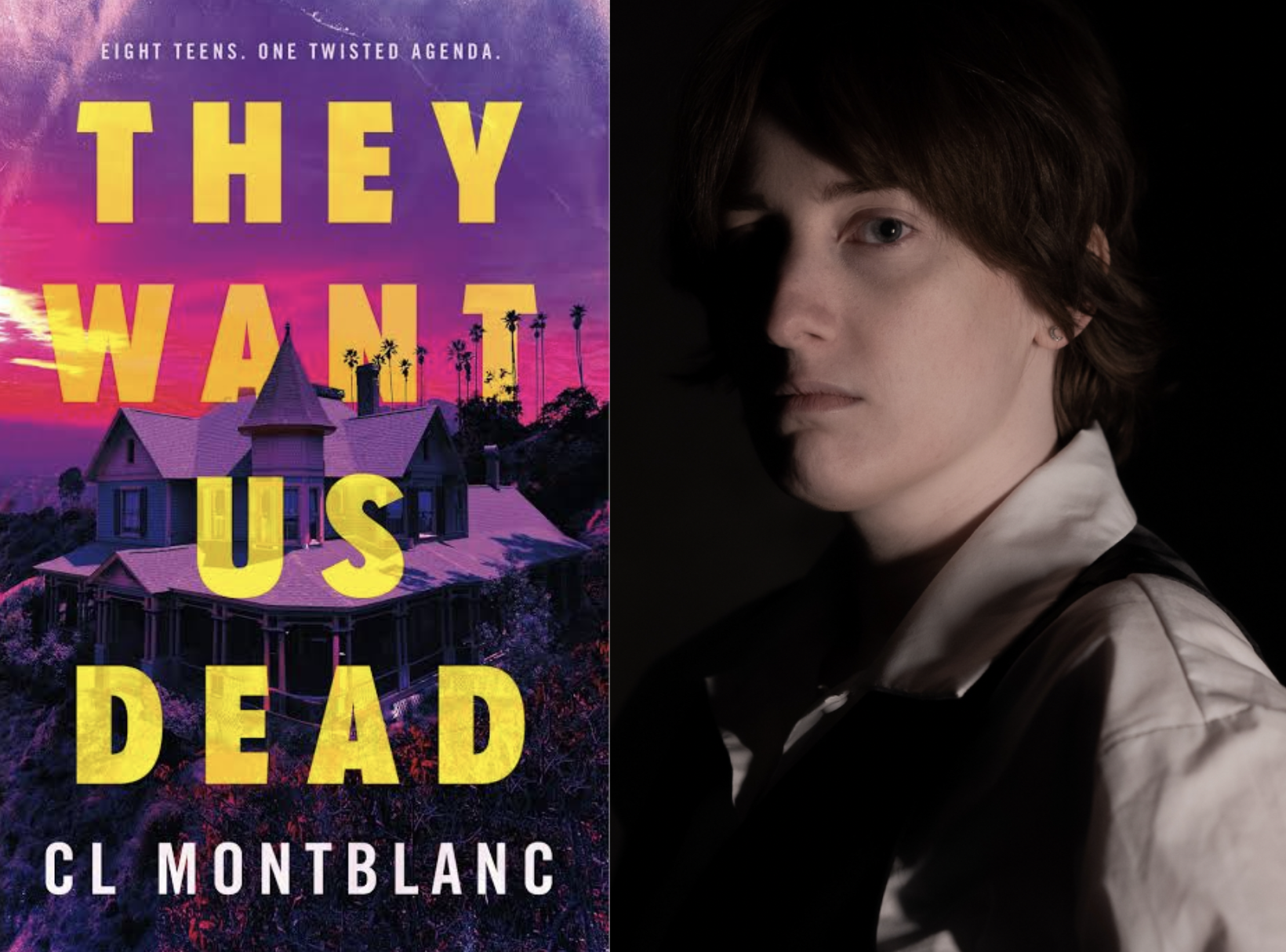
They Want Us Dead book cover, and CL Montblanc’s headshot.
CL Montblanc joined us for our Queer Book Club meeting on Wednesday, October 28th. This interview follows that conversation.
The Writing Owl: We discussed this during our Queer Book Club meeting, but can you tell our readers how you decided to write Sam as a non-binary character? What do you think is different about them compared with other non-binary characters you have read about?
CL Montblanc: There are a multitude of reasons—including "just 'cuz"—but I'd like to highlight one: I felt that I hadn’t seen enough incidentally non-binary protagonists in YA. There are not very many examples of it that I’m familiar with. Most are found within identity-focused stories, which are obviously important, but there is also something to be said for all of the other potential stories and experiences of a non-binary person. I personally don't frame much (if any) of my identity around gender, so it makes sense that some characters aren't going to, either.
The Writing Owl: You also mentioned during our conversation that the true crime aspect came to you as one of the options of who these characters could have been. Can you share a little more about the other possibilities? Who would they have been if they weren’t true crime aficionados?
CL Montblanc: A few of the other ideas were actors, fan-fiction writers, and rich nepo babies. The last one was by far the most fleshed-out. For example, Sam was written to be the heir of a tech company. There are still some relics of this version in the book: Jen being spoiled, Chaucer being British and having a ridiculous name (he was a prince). But there have been a lot of other stories about wealth and greed, and true crime felt more interesting to comment on, particularly from the perspective of these characters and their marginalizations.
The Writing Owl: One thing the book club members found interesting is your outline and what you showed us about how this story was written. Could you share a little bit of that process with our readers?
CL Montblanc: I always start a book with its characters. Knowing the characters helps me figure out what those characters might be up to, aka the plot. With a mystery novel, the start and end are pretty clear—how does the character get involved in the case, and how does it ultimately become solved? Then I think about “Save the Cat” style plot beats. With a mystery, you want a few different layers of questions and clues running at once, as well as twists and turns throughout. One technique I employ a lot is to figure out an interesting clue before I know what the clue will even mean, which I think is the exact opposite of how you normally do it. It's a fun challenge.
The Writing Owl: What is one detail or plot line that you believe must be included in a mystery?
CL Montblanc: Kissing. No, but I think mystery is already a narrow genre as it is, so I wouldn’t want to impose any more rules within it, other than that the mystery should be solved (at least the main mystery)! Which brings me to more of a personal preference—I love when there are multiple mysteries going on at once. My favorite mysteries I’ve read had me feeling smart for figuring out some twists while still being fooled by others.
The Writing Owl: Why do you think so many readers started doubting Dylan and believing he might be behind the murders? Was this character written with this ambiguity in mind?
CL Montblanc: It’s bound to happen when the protagonist is meant to dislike someone and find him suspicious. But characters who are “too nice” come off as suspicious too, don't they? Everyone is suspicious in a mystery novel at one point or another. With Dylan (and with everyone, really), my goal was to not completely sanitize the character in pursuit of “good” representation. I wanted to point out how unfair stereotypes of autism can be while also saying that it’s okay if you do fit certain stereotypes, or if you don’t act perfect. I strongly believe that everyone should be able to be a little evil and mysterious and cool. So yes, it was totally intentional.
The Writing Owl: What is one thing you’d want other queer authors to know?
CL Montblanc: What you're doing is really hard, and the instinct will be there to write something white-washed with mass appeal, but then you’ll have that one interaction at that one signing where a twelve-year-old has just come out to their parent, and now they’re looking for queer books to read together, and they’re so glad that you have written one, and everything is so, so worth it. Of course, it’s important to be realistic and to fight for yourself and your livelihood, but it’s also important to hold onto the nice things for your own sake.